• About
  • Blog
  • Contact
  • Favorites
  • Archive
Menu

Poppy Corners Farm

Street Address
Walnut Creek, California
Phone Number
Walnut Creek, California

Your Custom Text Here

Poppy Corners Farm

  • About
  • Blog
  • Contact
  • Favorites
  • Archive

A Policy Brief

September 28, 2020 Elizabeth Boegel

As you know, I’m a student, working towards my BA in Environmental Studies.

Today I finished a sample policy brief, which is a summary of information that can help people understand and make decisions about government policies. This was an assignment in one of my classes, and is my first try at this sort of thing, so it’s likely not perfect, but hopefully a good first effort. This particular brief was about accepting the fact of climate change and taking action to reverse it.

When I was writing it, I pretended I was writing it for you - my audience here, people who care about gardens and insects and homegrown food and nature.

So, I thought I would also share it here. If this is not your thing, then please feel free to exit out of this post and come back when I post pictures of kale or bees. But if you’re at all on the fence about this issue, or if you’ve never truly understood it, then you might enjoy reading my little effort to clarify it.

We’re all going to vote soon. The first presidential debate is Tuesday night. The topic of climate change will not be, as far as I know, part of the evening’s agenda, which is reprehensible in my opinion. I believe climate is the large umbrella under which everything else resides - issues of civil justice, health, money, education, our very well-being - everything is affected by climate change. We, as humans, will be impacted. We are already being impacted. Voting for candidates who will squarely face this issue is imperative. We simply cannot ignore it any longer.

“CLIMATE CHANGE: Acceptance and Action

There is compelling evidence for the existence of rapid climate change on our planet. In the last century, and particularly during the last 20 years, we have seen global temperatures rise, glaciers and sea ice melt, sea levels and temperatures elevate, oceans acidify, and the frequent occurrence of extreme weather events such as hurricanes and wildfires. These can all be traced to the meteoric rise of greenhouse gases in our atmosphere since the Industrial Revolution. Urgent action must be taken if we are to continue living on Earth. Along with reducing carbon emissions, reducing the use of and increasing the efficiency of energy and materials, and improving agricultural practices, we must also increase the resiliency and sustainability of our planet by reducing poverty, promoting equity, eliminating hunger, and providing education. Only by immediate and drastic actions can we save our planet and ensure the continuation of our species.

Scope of the Problem:

Greenhouse gases, consisting mostly of carbon dioxide (CO2) (81% of the total), and methane (10% of the total), are released as a consequence of human activity, and are generated by the production of fossil fuels (gas, coal, and oil, through the processes of mining and fracking) and the burning of said fuels (in combustion engines and power plants). The gases form a thick layer in our atmosphere, acting like a blanket and trapping heat (through refracted infrared radiation). This has caused the temperature of the lower atmosphere to rise to unhealthy levels. In 2017, the temperature reached 1 ℃ above pre-industrial levels. We are rapidly warming and may soon approach 1.5 ℃, which will have dire consequences for every living thing on our planet.

It will take centuries for the excess gases to be removed from our atmosphere by natural processes, so even if we are able to stop all emissions now, we will still experience climate inertia and a continued rising of atmospheric temperatures. The impact of these rising temperatures will continue to be experienced. This is why immediate action must be taken; so that we do not reach the tipping point of no return.

The impacts of greenhouse gas, and the resultant warming, are numerous and detectable now, and will become more so in the future. Physical impacts include extreme weather, which we are experiencing at present in the summer of 2020, on both coasts, as wildfire rips through the West; the East is confronting a horrific hurricane season. According to the NOAA, “the August contiguous U.S. temperature was…. 2.6℉ above the 20th century average and ranked third-warmest August on record.” Sea level rise is imminent as we experience more sea ice melt.

There are also numerous impacts on our ecosystems, with species migration and extinction due to destruction, changing temperatures, and lack of food and water. With marine environments acidifying, there will be hugely harmful consequences to the aquatic ecosystems.

The impacts of this warming to humans include reduced crop production, a greater incidence of infectious disease, and reduced supply of fresh water. We also cannot ignore the mental and emotional threat of climate change. According to the American Psychiatric Association, “Exposure to climate- and weather-related natural disasters can result in mental health consequences such as anxiety, depression and post-traumatic stress disorder.” And according to the Centers for Disease Control, “Climate change poses many risks to human health,” including heat stroke and respiratory events.

Human migration is also a very real consequence of climate change. As an example, the 1998 monsoon floods in Bangladesh devastated infrastructure and agriculture, leaving 21 million people homeless.

Current Approaches:

In December of 2015, the COP 21 (Conference of Parties) met in Paris for a climate conference. The IPCC (Intergovernmental Panel on Climate Change) was invited to produce a special report for the event. IPCC’s “Special Report on Global Warming of 1.5℃” was written by 74 scientists from 40 countries, and took two years to produce. The assessments and recommendations set forth in this report were adopted by the countries represented at the Paris conference, in an historic consensus (“The Paris Agreement”). Nearly all of the major greenhouse-gas emitting countries ratified the Agreement, which accounts for about 90% of global emissions (the United States has since pulled out of the Agreement, a decision which was made by President Trump in 2017). The Agreement’s aim was (and is) to keep global warming below 2℃. The IPCC recommended that, in future, “cumulative emissions are kept within a budget by reducing global annual CO2 emissions to net zero.” Mitigation pathways include producing power by renewable resources only (hydro, wind, solar, and bioenergy), reduced energy consumption, increased energy efficiency, and land-use changes. The report also included suggestions for sustainable development, because poverty eradication and reducing inequalities improves the well-being of humans, particularly in a warming world. The report states, “… sustainable development has the potential to significantly reduce systemic vulnerability, enhance adaptive capacity, and promote livelihood security for poor and disadvantaged populations.”

A further current approach being used by all humans on Earth at the moment, and that will be used even more in the future, is adaptation. As the climate warms, escape from the impacts caused by increased carbon emissions is impossible, so we will need to learn how to live with them. Planning for these impacts, and implementing measures to combat them, is crucial. Both local and indigenous knowledge can play a part in helping us to prepare. Bracing for more extreme weather events, and learning how to make our living spaces safe, is something we are already doing. The recent wildfires in the West have shown us that the ancient knowledge of prescribed burns can help keep our forests healthy, and less vulnerable to extreme firestorms. The planting of trees can help provide shade to neighborhoods that are experiencing extreme heat. The mitigation of soil erosion can help prepare coastlines for hurricanes. Likewise, we are already taking steps to improve our supply chains with the increased use of local farms and producers. The implementation of regenerative soil practices can increase the health of our crops and provide water capture in the face of drought. Further adaptation will be important as we move steadily into the future of climate change.

Recommendations:

The most immediate need is to reduce carbon emissions. A multi-tiered approach is recommended. This includes halting the production and burning of fossil fuels, with a move to clean, renewable energy (solar, wind, hydro); halting the deforestation of the World’s largest forests such as the Boreal and the Amazon; and implementing regenerative agricultural practices such as no-till, cover cropping, and eliminating the use of chemical pesticides and fertilizers.

Simultaneously, we need to increase the amount of carbon sinks on the planet. According to Ocean & Climate Platform, “A carbon sink is a natural or artificial reservoir that absorbs and stores the atmosphere’s carbon with physical and biological mechanisms.” The ocean acts as a natural carbon sink, holding carbon in the deep waters. Humus-rich environments such as peatlands, and vegetative areas such as forests, also sequester carbon. Soil is a tremendous carbon sink, so the implementation of no-till agriculture is important to hold on to that carbon.

Artificial carbon sequestration is also being considered. These are processes in which carbon emissions are captured at the point of product and buried. Proposed methods include pumping carbon dioxide deep into the ocean, piping it into underground chambers such as oil reservoirs and coal seams, and injecting it into layers of magnesium- or calcium-rich rock.

Adaptation will also need to increase as the planet warms and impacts are felt. Education is important here, as well as compassion, as we all emotionally and physically come to accept the fact of climate change. Ignorance will no longer be an acceptable choice.

Summary:

The studies produced by the international team of scientists for the IPCC have shown clearly that climate change is occurring now, and that it has been created by human activity, primarily by the production and burning of fossil fuels. The evidence of climate change continues to grow and awareness is ever-present as we begin to feel the effects of its impacts in the rise of global temperatures and extreme weather events. Urgent action is required to mitigate the continued rise of greenhouse gases, and to adapt to the effects of them on our planet. Complacency and willful ignorance are no longer permissible. Humans in all nations must join together to present a strong and unified front, creating new solutions and bravely facing the changes we face. Only by working together can we survive, and thrive, in a new world.

Sources:

Intergovernmental Panel on Climate Change: https://www.ipcc.ch/sr15/

World Meteorological Organization: https://public.wmo.int/en/resources/united_in_science

World Resources Institute: https://www.wri.org/blog/2020/02/climate-change-mitigation-adaptation-strategies

Ocean & Climate Platform: https://ocean-climate.org/?page_id=3896&lang=en

Carbonify: http://www.carbonify.com/articles/carbon-sequestration.htm

United Nations: https://unfccc.int/process-and-meetings/the-paris-agreement/what-is-the-paris-agreement

American Psychiatric Association: https://www.apa.org/monitor/2016/07-08/climate-change

Centers for Disease Control: https://www.cdc.gov/climateandhealth/pubs/EXTREME-HEAT-Final_508.pdf

International Organization for Migration: “Migration and Climate Change,” No. 31 https://www.iom.int

National Oceanic and Atmospheric Association: https://www.ncdc.noaa.gov/sotc/national/202008”
image credit: IPCC
image credit: IPCC


8 Comments

Planting the Winter Garden/Thoughts on Water

September 20, 2020 Elizabeth Boegel
IMG_5319.jpg

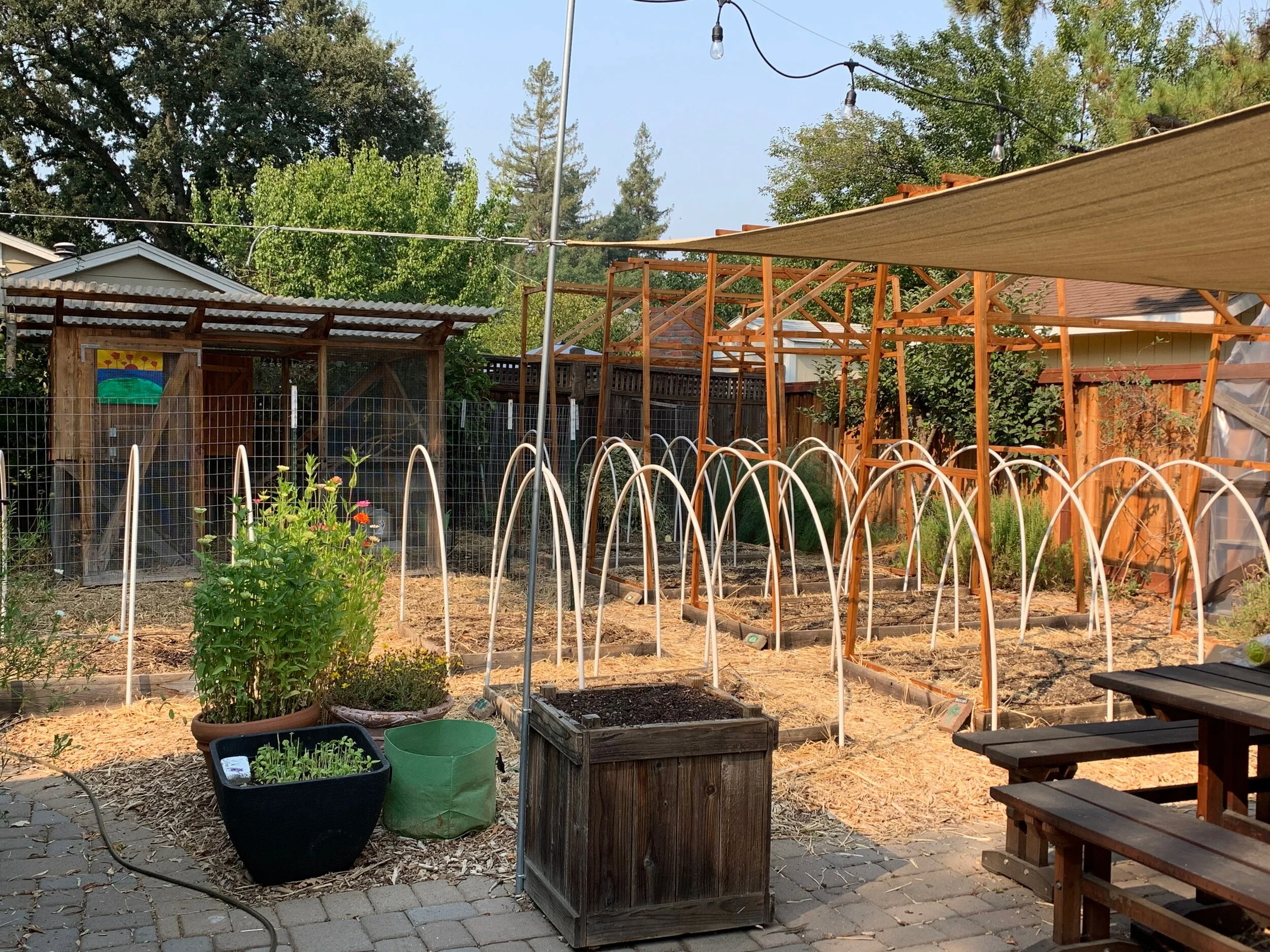
We had a brief respite from the smoke this weekend and were able to get all of the north garden planted for winter. This involved taking out all of the tomatoes and peppers, amending the soil, doing a little aeration of the soil, replacing the drip lines, and planting seeds. The north garden will be home to brassicas and greens, this year. I’ve decided to skip Brussels Sprouts, as I never have much luck with them. But all the other usual suspects are in, and we’ll enjoy eating them early next year. Greens will be available to eat all winter, which we love.

IMG_5316.jpg

The next job is to cover the hoops with row cover, to keep the birds and the cabbage white butterflies OUT!

I had mulched the tomatoes and peppers heavily with organic rice straw, and one benefit of that was that the soil level was still very much as it looked in April - still level with the top of the raised beds. I thought that was interesting. Another benefit of the straw is that I was able to move it from the beds to the chicken run, and now they have a new layer of carbon to scratch through and soil with their droppings.

In the south garden, Tom took out the beans and cucumbers and I took out the pumpkins and some cover crops. Now we have snap and shelling peas planted, which might crop before cold weather - we’ll just have to see. I’m a little early on my winter planting this year, so I’m not sure how everything will behave.

Our seed garlic will be arriving tomorrow, so I also prepared a bed for that. However, I had forgotten that we had a water issue that needed investigating. We noticed some extremely wet places in between raised beds last May, and Tom dug down to see if there was a leak in the irrigation, and didn’t find anything. We dialed down the amount of water going to those beds and decided to watch it this summer, since I had already planted the summer garden. That seemed to solve the problem, except for one very wet place in between two of the beds. So Tom dug a bunch of holes again today to see if there was a leak. Surprisingly, there wasn’t. And yet we see water seeping out the bottom of the sides of two raised beds! Tom thinks maybe the lower levels of the soil are so compacted that the water is dripping down to that level and then running off. This sounds possible to me. We are on heavy clay, and though we amend the soils each year with all kinds of organic matter, it takes a long time to change the tilth of soil. I also practice no-dig methods, which ensure that soil life is not disturbed, and in theory should actually improve the soil’s texture, but it could be that I need to add more organic matter down lower in the beds, next to the hard pan. So that’s what I’ll do.

IMG_5317.jpg

This whole issue spurred us to discuss our watering habits more generally. Watering is kind of a crap shoot. In the summer, our plants seem SO dry and tired, and the soil seems dusty and dry, no matter how much we water. And we water a LOT. We are using a lot of resources. The general rule (and this is so general, it’s almost silly) is that plants in the ground (not containers, not raised beds) need an inch of water a week. Well, in a place that rains, that’s easy to calculate; but we have no rain nine months out of the year. So the soil is never soaked, and it is never sodden in the summer months - it is bone dry. Add to that very low humidity in the air (10% humidity is quite usual here in the summer months), and very hot temps (often over 100), and that means the plants are transpiring like crazy. And, we grow most of our crops in raised beds, which tend to stay drier anyway.

We did a whole bunch of calculations and we converted an inch of water to gallons per week, and even when we set the drips for 10 minutes a day, we’re still giving the garden more than two inches a week. You’d think that would be enough, more than enough! But in the summer heat we often drip for 15 minutes a day and the plants are still wilting and sad looking. They produce, though. So I suppose they are getting just enough. But honestly, I am just guessing.

We want to be good stewards of water, here in our dry dry dry West. And yet, we also don’t want all of our hard work go to waste - we want the plants to thrive. Growing at home is still a better use of water than buying fruit and veg from the market, so in the big scheme of things, we are conserving. It just feels bad to be using so much water. If we had a lawn, would we even think twice? Most people don’t.

Well, one thing we can certainly do is make sure that we don’t have any runoff like we did this past Spring. So, organic matter to the rescue! We are also thinking of buying a soil moisture meter, so we can start to really determine how the water is behaving deep in the soil.

Tags vegetable garden, raised beds, water
Comment

Random Thoughts

September 13, 2020 Elizabeth Boegel
HPIM1891.jpg

This is Camp Okizu in 2007, our beloved cancer camp in Berry Creek, CA. We started going to camp as a family in 2004, and both Adam and Rin have attended by themselves every summer since they were eight. Adam has been a counselor for two years now, this past summer online, which was challenging but very rewarding for him. Okizu provides camp free of charge for children with cancer and their families. We love it there.

Okizu was badly burned this past week, in a massive fire that had been burning since our first terrible heatwave in August, but was fanned and spread by the high winds we had during our most recent terrible heatwave, a week ago. Berry Creek was one of the communities that was hardest hit, with a wave of fire that bore down so quickly that many people simply could not escape.

Here’s how the lodge looks now.

image credit: Sacramento Bee

image credit: Sacramento Bee

We will do everything we can to help Okizu rebuild.

The smoke is still quite bad here in California, but we are hoping it will move out this week. Unfortunately we need wind to move it, and wind isn’t so great either, in terms of fire. Oregon is having a hell of a time right now, and our hearts are with everyone involved there. There are fires burning up and down the west coast and the western third of the country.

Fire has been much on our minds, but classes and work and life do continue despite it.

The day after Labor Day, a professor of mine read aloud an excellent poem, which I thought you might enjoy as much as I did. It’s called “Worker” and was written by the poet laureate of Berkeley, who also happens to be my professor’s neighbor.

“He who works with his hands is a laborer,

He who works with his hands & his head

is a craftsman, he who works with his hands

& his head and his heart is an artist,

so you said, brother Francis.

Were you then an artist, brother,

rebuilding St. Damian & the chapel

Our Lady Queen of the Angels of Porciúncula?

I do not know man or woman who works

only with the hands without the head

weighed down as it be or without heart

though it be bitter & hurting.

It is unjust circumstances that separate

the hands from the head & the heart.

Laborers, crafts-folk, artists

we are all workers —

we earn our bread & put

bread, & wine, on the tables.

If poverty there be it is no fault of ours;

the Earth is generous when it does not fall

into the hands of the greedy.

If there is baptism of water & blood

so also there is of sweat.
”
— Rafael Gonzales

As we drove down highway 101 from San Jose to San Luis Obispo on the 4th to drop Adam off at college, we drove through the beautiful salad bowl that is that particular valley in California. But the bowl was filled with smoke, and we were in a terrible heatwave, and the migrant workers, covered head to toe in flannel to ward off the rays of the sun, and masked because of Covid, were bent over harvesting cauliflower and romaine, working for pennies. That is definitely a baptism of sweat. I hope our future world honors labor, hard labor, essential workers, more than it does now.

Finally, here are a series of videos for you, which are part of my Environmental Justice module in one of my classes. Each one is inspiring - some are easy to watch and very entertaining, and some are hard to watch and may make you feel uncomfortable. Personally I learned from each one and thought you might be interested too.

Today we realized our family has been sheltering in place for six months.

I still haven’t torn out the summer garden. I keep meaning to, but every weekend carries its own challenges; one weekend it’s 110 degrees, the next the air quality is so bad that we have to stay inside with doors and windows shut. On Labor Day, it was 111 degrees here. Two days later it was 68 because the smoke had blocked so much sun. It’s been a hell of a ride.

Tags california, environment, food justice
4 Comments

No Words

September 9, 2020 Elizabeth Boegel
Sugarloaf Open Space, looking west

Sugarloaf Open Space, looking west

the car this morning

the car this morning

smoke layer

smoke layer

10:30 am in our living room

10:30 am in our living room

orange glow

orange glow

dining room, 10:30 am

dining room, 10:30 am

looking north

looking north

Just a couple words: We are ok - the nearest fire to us is 44 miles away. But a lot of people are not ok, clearly. Our hearts are heavy for our home state and for the entire west coast.

Tags fire, west coast, california
6 Comments

Reader Question - Cover Crops

August 29, 2020 Elizabeth Boegel
Crimson clover, a winter cover crop in warm climates

Crimson clover, a winter cover crop in warm climates

Did you know that you can email me directly if you go to the ‘contact me’ page on this website? I would absolutely LOVE to answer any question you have, and if I can’t answer it, I’ll be honest about that, too. It’s all too obvious that I am running out of things to write about. When I was taking Horticulture classes, I was always learning something new about gardening, or trying experiments out in the lab, and I had lots of information to share. Then I swerved briefly into more general science classes, which still had some good, relatable info. But now I’m fully into my upper division courses, which are all for my Environmental Studies degree and include boring things like data collection and carrying capacities and population control and clean energy. Well, they aren’t boring to me, but they certainly aren’t the focus of this blog, and aren’t as fun to read about as bugs and vegetables and flowers. So I really appreciate questions! They give me a chance to write about fun things and to question my knowledge and opinions of them and of course, that way we can all learn together, which is my favorite thing of all.

This morning I got a wonderful email from a reader named Jill, who lives not far from me: “ I sadly lost most of my garden due to the heatwave and an irrigation issue. I’m looking at cover crops and know nothing about the subject. Do you have any tips or links to places you buy the seeds from. Maybe some simple do’s and dont’s? “ Thank you Jill! Thank you for reading the blog and thank you for this question and thank you for your faith that I can answer it!

Buckwheat, a summer cover crop in warm climates

Buckwheat, a summer cover crop in warm climates

Cover crops can seem intimidating and confusing, so let’s start from the beginning. What is a cover crop? The simple answer is that a cover crop can be anything you want it to be. The Oxford Dictionary definition is “any crop grown for the protection and enrichment of the soil.” Farmers tend to use specific plants to satisfy specific requirements, which can be very important, especially if you want to grow without inputs i.e. chemical fertilizers. Some plants provide nitrogen, some phosphorus; others attract beneficial insects, and still others provide biomass for feeding animals. Some are grown during the summer, and some are grown during the winter. Some are grown after a specific cash crop, to replenish certain nutrients.

If you’re a farmer, and you’re making a living growing and selling your crops, you’re going to want to know a lot more details about cover crops and how they can be used to save you money. But if you’re a regular home gardener, your needs are different. You want something to improve the soil, attract beneficial insects, look pretty, and feed your compost pile when it’s done growing. Maybe you want to avoid buying soil amendments this year (they’re going to be hard to find, considering how many people are gardening for the first time). Maybe you don’t like the structure of your soil, and you want to improve its water-holding capacities. Maybe you like birds, and you want to feed insects that will in turn become food for the birds. These are all fine reasons to grow a cover crop.

The thing that is most important is that you have a living root in the ground at all times. Now, if you live in upstate NY, you know that eventually that root will likely die, and that’s the way it’s supposed to be, and maybe even you time a crop so that it winter-kills and you don’t have to cut it down yourself. If you live in California, however, you can grow different cover crops at different times of the year, year-round. Having a living root in the ground is what improves your soil. The plant harvests sunlight, makes sugars, and pumps those sugars down into the roots and into the soil. This attracts microbiota, tiny creatures that feed on the sugars that the plant provides. In turn, they poop, providing micro-manure to the soil, and they burrow, improving air flow to the roots, and they die, recycling nutrients, and they move a ton of soil, making it rich and crumbly and perfect. If there’s no root in the soil feeding the microbes, then they move on or die off (or become very, very sluggish, waiting for the next influx of food). It’s not the plant that is feeding the soil, it’s the animals that are feeding the soil - the bacteria, fungi, protozoa, and nematodes - the primary and secondary consumers. When you spread manure or compost on the soil, it doesn’t feed the plant - it feeds the soil life, which in turn form these associations with the plant roots and provide the nutrients the plant needs to thrive.

image credit: center for food safety

image credit: center for food safety

So if you look at it this way, any plant can be a cover crop. No matter what kind of plant it is, it is going to continuously pump sugars into the soil and feed soil life, therefore improving your growing medium.

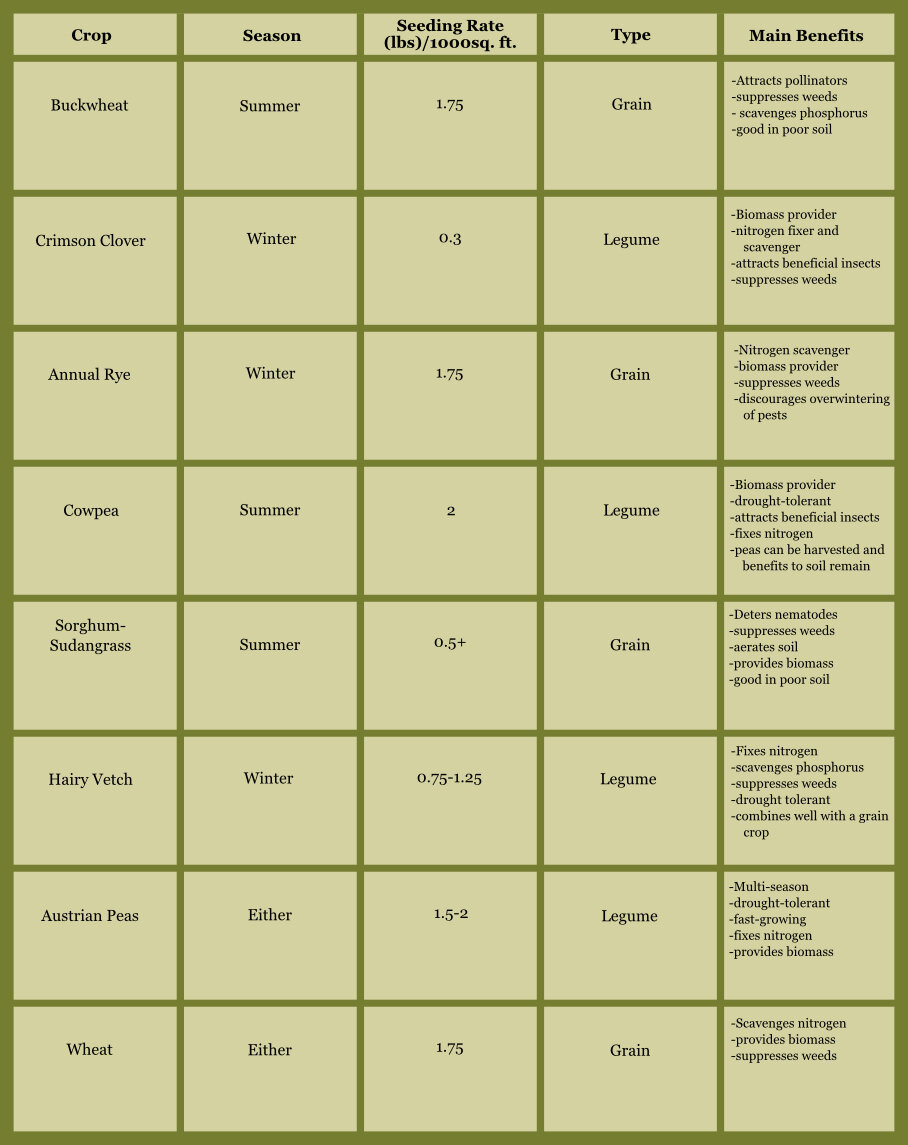
However, some plants need a lot of nutrients. If you’re planning a summer garden full of squash or melons, for instance, you might want a high nutrient load in the soil before you plant them. Why not grow a crop that will also add specific nutrients to the soil? Here is a handy chart, provided by the Organic Growers School, to help you determine which crop you need at which time.

image credit: the Organic Growers School

image credit: the Organic Growers School

Don’t worry too much about the seeding rate. I just spread it on thickly, and that does the trick.

I’ve grown many different specific cover crops, and I tend to stick to two - crimson clover in the winter, and buckwheat in the summer. Some years I don’t use them at all. Some years I plant them intercropped with other plants that I am using for food. Some years I grow them alone in specific beds. They’re both great, but both require cutting and removing before they set seed (at least here in CA), or else they will seed everywhere (which is not the worst thing in the word). I’ve also done several mixes, especially in summer, that combine many species to provide many different nutrients. This is actually proving to be best for the soil, generally. If a living root in the ground is good for the soil life, then a wide diversity of roots in the ground would naturally be even better. I’ve also grown winter wheat and oats, which provided me with the best variety of beneficial insects I’ve ever seen in my garden. Long grass is apparently second only to a pond for attracting wildlife, and we saw that firsthand.

wheat.jpg

Many seed houses sell cover crops, but the best place I’ve found is Walnut Creek Seeds in Walnut Creek, Ohio (I know, it’s a coincidence that my town is also named Walnut Creek). They’re super-friendly, the farmer (Dave Brandt) has pivoted his business from growing corn and soy to growing cover crops, and he is also involved in a lot of research with the NRCS to show how cover crops can save money for traditional farmers, improving crops, soil, water levels, and erosion. Their prices are incredibly reasonable. They also sell specific gardening mixes for the home grower. I’ve used both the summer and the winter mix, and can vouch for them. Mr. Brandt is also one of the first conventional farmers to help develop special seeding equipment to enable farmers to plant their cash crop directly into the residue from a cover crop. He has a lot of videos on his website, and I think they are fascinating. (I have also ordered phacelia from them, by the pound, for early spring seeding in my pollinator gardens. The bees go crazy for it.)

If you’re interested in how soil can be a huge catalyst to improving our planet (and some history on how it’s disappearance has contributed to societal failure), an excellent book is Growing a Revolution: Bringing our Soil Back to Life, by David R. Montgomery. If you’re looking for a nice film to help you understand these concepts, look for Symphony of the Soil, which came out years ago and is still one of the best films about soil I’ve ever seen. For a crash course on soil health and how cover crops can be used to improve your land, you can’t do better than Living Web Farms’ series with Roy Archuleta and Dave Brandt - these videos will blow your mind.

If I were Jill, and my garden had been decimated by heat and smoke (mine is pretty sad too, sister!), and if I wasn’t planning on winter food crops, and I wanted to improve the soil, I would plant buckwheat right now. It’ll grow and flower quickly in our late summer/early autumn heat; it’s quite a pretty plant, with lovely tiny white flowers. Around late October or early November, I would cut it down and lay it on top of the soil where it grew. This will provide cover for the soil over the winter. (Studies have shown that it’s better for the soil if you just lay the residue on the top, rather than turning it under.) Or, you can add that residue to your compost pile. I would then plant either a winter mix of grain, clover, peas, and radish (or the mix Dave sells) right into those same beds, and let it grow a bit before the real winter hits us. When it begins to warm up again in January/February, that cover will take off and grow like mad, and you can let it go until you are ready to cut it down and plant your spring crops. This will do wonders for your soil, and you will also be feeding pollinators: Both now, with the buckwheat, when it’s hot and crispy outside and there’s not a lot to eat, and early in spring, when the bugs are emerging from their winter dens and need nutrition, pronto.

Do any of you use cover crops regularly? What’s your experience with them? Do you have any tips for Jill (and the rest of us)? If so, please leave a comment down below. Good luck, Jill! Let me know if you have any more questions.


Tags cover crops, reader questions, vegetable garden, beneficials, soil
3 Comments
← Newer Posts Older Posts →

Subscribe

Sign up to get email when new blog entries are made.

We respect your privacy. We're only going to use this for blog updates.

Thank you! Please check your email for a confirmation notice to complete the subscription process.

Powered by Squarespace