• About
  • Blog
  • Contact
  • Favorites
  • Archive
Menu

Poppy Corners Farm

Street Address
Walnut Creek, California
Phone Number
Walnut Creek, California

Your Custom Text Here

Poppy Corners Farm

  • About
  • Blog
  • Contact
  • Favorites
  • Archive

Indigenous Land Acknowledgement

July 4, 2020 Elizabeth Boegel
IMG_4763.jpg

I’m taking a really interesting summer class called Social Issues in Agriculture. In it, we are exploring and learning about agroecology, biocultural memory, and political ecology. I have a lot of knowledge and experience in growing things, but I’ve never really considered the history of the land and the indigenous peoples who lived here first. It’s one thing to plant a ‘three-sisters garden;’ it’s another thing entirely to look at the garden from the perspective of the present while honoring the people who gathered, grew, and ate here long ago. I’ve looked at the geology and land processes, the geography and natural hazards of my property, without acknowledging the people who were here first, and the ones that moved in by colonization.

We have had several interesting lectures in my class, and one of them was proceeded by a verbal Land Acknowledgment and moment of silence to honor those that came before. I had never seen or heard of a Land Acknowledgment before, and I found it moving and important. In this time of increased awareness of the issues Black Americans face, I am also finding that there is a need for awareness of those that Indigenous People face.

What is a Land Acknowledgment? According to Northwestern University, it is “a formal statement that recognizes and respects Indigenous Peoples as traditional stewards of this land and the enduring relationship that exists between Indigenous Peoples and their traditional territories.” Why do we recognize them? It is “an expression of gratitude and appreciation to those whose territory you reside on, and a way of honoring the indigenous people who have been living and working on the land from time immemorial. It is important to understand the long standing history that has brought you to reside on the land, and to seek to understand your place within that history.”

IMG_4750.jpg

So, I’d like to try my best to acknowledge the people who historically lived on the land on which I live and work. It is apparently better to do this badly then not at all, so here is my attempt. I live in what is now south Walnut Creek, California, a land originally populated by the Bay Miwok tribe. The Bay Miwok tribe was split into several other tribes, whose names were recorded in 1769 when the Spanish first came to California in force (there is some confusion about whether or not the Spanish actually gave the tribes these names): The Chupcan, Julpun, Ompin, Saclan, Tatcan and Volvon tribes. The Saclan tribe lived where I live now. According to our local San Ramon Valley Museum, “the Bay Miwok tribes each had one to five semi-permanent villages and numerous temporary camping sites within a fixed territory of about 6 to 10 miles in diameter. Each tribe knew its land and boundaries intimately and owned the land communally. They probably lived within different watersheds, consumed seasonal foods such as acorns, seeds and salmon and took advantage of their proximity to waterways. The Bay Miwok tribes each ranged in numbers from 200-500 at the time of European contact.”

IMG_4758.jpg

The Saclan were apparently leaders in several rebellions of the region, and resisted the Spanish troops who came after them in several expeditions between 1795 and 1805. The refused to go peacefully to the Missions, but were eventually “subdued” by the Spanish military. The Spanish Colonial period extended to 1821, and the Missions were in charge of various areas; the San Jose Mission was likely the one that incorporated the Saclan people into its territory. The land was used for grazing animals (which destroyed our native ecosystems). In 1821 Mexico gained control of Alta California, and this period was dominated by rancheros and traders. Four Mexican land grants divided present-day Walnut Creek, and our area belonged to Jana Sanchez de Pacheco. His grandson is apparently the first person to build a roofed house here, in 1850, according to our local history. He named the territory Rancho Arroyo de Las Nueces y Bolbones (“Walnut Creek” and “Bolbones,” another name for the local indigenous people). He owned 20,000 acres, employed Mexicans and Natives, and bought sheep and cattle from San Jose Mission which continued to graze on these lands.

Of course, the Gold Rush began in 1849, and the miners continued to decimate the land and the tribal peoples. California became a state in 1850, and according to our county history, passed laws allowing the natives to be enslaved by any white man. Women and children were taken and sold. In 1863, this law was repealed.

In 1855, the first hotel was built in our city, and in 1856, Hiram Penniman laid out the town site and called it “The Corners.” That community was largely a farming one, planting vast pear and walnut orchards. In 1862, the first Post Office was built here, and the town was renamed Walnut Creek. In 1949, our immediate neighborhood was built, along with all of the schools our children attended.

We moved here in 2004.

I found it fascinating to research all of this, most of which I knew in bits and pieces before, but having a more complete picture is really good. I want to honor those that came before. I think it’s important that we all do. I encourage you to take some time and do the same. You might already know most of it, but you may learn something new, and it’s very good for us to acknowledge the harm our ancestors did to both the land and the people that came before. I am sad that there is a whole range of local knowledge that has been lost due to colonization, slavery, and genocide. There are very few Bay Miwok people left, and the Bay Miwok tribe has never been recognized by the federal government of the United States. Some California tribes signed treaties with the United States government in 1850, which gave up quite a lot of their ancestral land; it appears the Bay Miwok was not one of these tribes (for a fabulous history of the tribes in our area, click HERE to see a school curriculum put together by East Bay Regional Parks).

There is a cultural memory that has been lost, of what to gather and grow and cook here. There is a richness of diversity that has been lost. An entire People have been lost. I am also sad that a lot of our local land was destroyed by grazing, and now is colonized by plants that didn’t belong here, which destroyed our local ecosystems. Many of the plants and insects that thrive now came here as ballast on Gold Rush boats.

IMG_4743.jpg

Of course, while I garden with a lot of plants native to this area, I also grow an awful lot of things that don’t belong here at all, and persist in keeping European honeybees which are non-native. I continue to wrestle with these issues and vacillate back and forth between championing this kind of growing, and vilifying it. We all need to make those decisions for ourselves. We need to know all the facts and acknowledge our actions, either way.

The same can be said for knowing who lived and worked on our land before we did. It is a way to honor them, to recognize them, to look them in the eye metaphorically and say “I see you.”

Tags learning
7 Comments

Pollinator Turnover

June 28, 2020 Elizabeth Boegel
IMG_4532.jpg

This is how the South Pollinator Garden looked on June 1. The poppies had largely finished flowering, and the Clarkia ‘Farewell to Spring’ was just starting to bloom. Everything was tall and green. But by last week, the Clarkia had begun to brown and topple, and though it still had plenty of flowering left to do, I wanted to do the summer clean-out and turnover, so that I could begin growing the flowers that will bloom all summer and right up to our first frost.

This is a massive project that I do twice a year - once around now, and then again after the first frost. As I have said recently, I’m starting to think about doing something different in this area. I’m still mulling it over, but it will surely be a winter project, so I have some time to think more about it before I make any big changes. Anyway, yesterday I spent the day clearing out the old stuff, everything I didn’t want to keep, all the annuals that were spent as well as some woody perennials that were past their prime. I filled up two green bins (mine and my neighbor’s) and added several feet to the compost pile. This morning, Tom and I went out together and moved the drip lines out of the way, cleared and righted all the stepping stones, and then spread 6 cubic feet of compost over the ground. We replaced the drip lines, made sure they were all working correctly, and then I seeded several different summer/fall annuals: Cosmos (‘Purity’), Zinnia (‘Cut and Come Again’), Cornflowers (mixed colors), Tithonia (Mexican Sunflower), and Rocket Larkspur (blue). I decided to sow these in patches of single species rather than mixing them all up and flinging them everywhere. If it works, we’ll have patches and lines of different flowers for cutting. It’ll be a bare month in this garden, as the plants grow, but the bees have lots of other food to eat right now - the other borders are full of blooms, and the beds are full of squash and pepper and cucumber blossoms.

This is how it looks now.

IMG_4726.jpg

Quite bare, which is one of the reasons I want to rethink this area.

Meanwhile, here are some photos of the plants that survived and that I love.

Clematis ‘Arabella’ - this is a type 3 clematis which requires cutting back to the ground in winter, so that it blooms on the growth put on in spring.

Clematis ‘Arabella’ - this is a type 3 clematis which requires cutting back to the ground in winter, so that it blooms on the growth put on in spring.

a Monardella (I don’t know which kind) that reliably comes back year after year

a Monardella (I don’t know which kind) that reliably comes back year after year

Dahlia - can’t remember which kind, but it has dark foliage. I’m in love with dark-leaved dahlias and have added several more this year in other places.

Dahlia - can’t remember which kind, but it has dark foliage. I’m in love with dark-leaved dahlias and have added several more this year in other places.

Eryngium

Eryngium

This was a weekend well spent in the garden, tying up cucumber and bean vines, and adding cross-braces to the squash trellises. Meanwhile we have been getting a few cherry tomatoes a day, and the big ones are starting to break and change color. Tomato season, hooray!

Tags flower garden, pollinators
Comment

Braiding Day

June 21, 2020 Elizabeth Boegel
IMG_4692.jpg

Last year, despite planting two beds of garlic, our harvest was extremely stingy. The bulbs were small and underformed, and while we used it as long as we could, it was a pain to peel and mince. I had trouble with my shallots last year too, so I gave myself a list of to-do items to make sure that this year’s garlic looked great. (The shallots, another story, as they were felled by allium aphids. We’re going to give shallots a pass for the foreseeable future.)

Here’s the my list, which I followed mostly to a T (I’ll explain outliers below): “So, this Fall, here’s what I’m going to do. One, order seed bulbs directly from the grower (Filaree Farms has been recommended to me). Two, I’m going to plant them later, in November rather than October. Three, I’m going to plant less of them, only one bed for shallots and one bed for garlic. Four, before I plant, I’m going to break my no-till rule and make sure the soil is loose and that I’ve added plenty of compost and maybe some grit to increase drainage. Five, I will interplant with crimson clover, which should add a place for the good bugs to proliferate. Six, I will plant them in a place that has more shade in April (and maybe cover them too), and not in the place where I want to put tomatoes next year, which need to go in May 1, which is part of Seven, I will leave them in the ground until June. Eight, I will remove the irrigation lines for the last month of the growing season. Nine, I will make sure they are totally ready before harvesting. Ten, I will cure them differently, in a different place, allowing more airflow and more time (this will be difficult because they need to cure in shade). And finally, I will allow them to cure for longer, and inspect them thoroughly, before I bring them in the house.”

IMG_4697.jpg

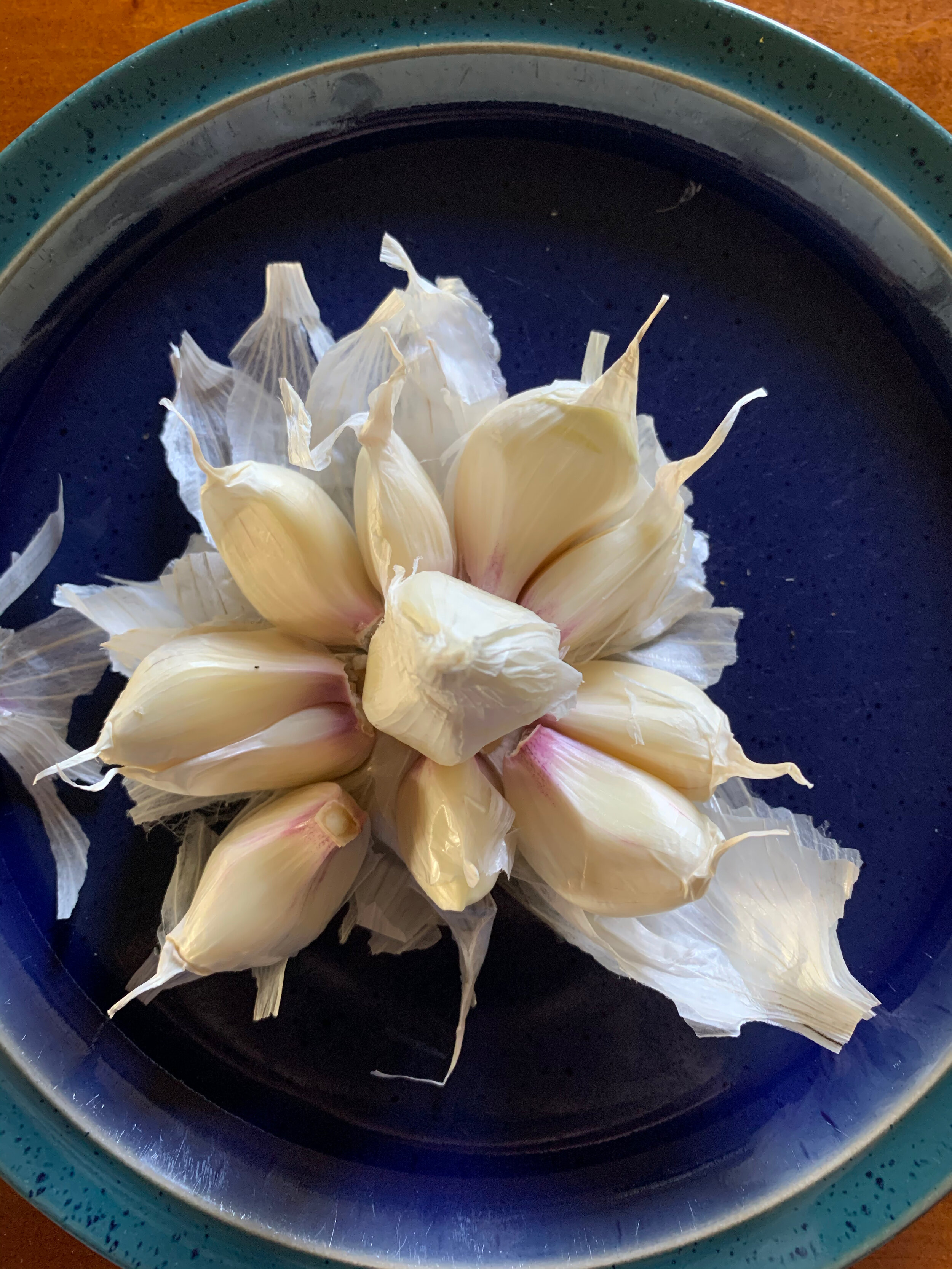
Well, what do you think of this year’s crop? Doesn’t it look marvelous? We yielded about 60 bulbs, enough for one per week with a little extra to either use or save for seed. The bulbs are fat and well-formed, and the individual cloves are huge. The skin is extremely papery, as we dried them in the hanging garage rack for four weeks solid. They were easier to trim and braid. It tastes excellent. In short, even though I harvested it just a touch early, it was a perfect result.

IMG_4703.jpg

This variety, which we have decided is our favorite of all the kinds we’ve tried, is an heirloom called Inchelium Red. I got the seed garlic from Filaree Farms (and they are already selling for fall delivery, so I would buy now before they run out) up in Oregon.

If I had to choose one thing of the many that I did differently this time, I would say the drying process was the key, and by that I mean two things: Taking the drips off a month before harvesting (to let the bulbs dry out in the ground and start the process) and hanging them vertically on a rack in the hot, dry garage. Our former method of piling them up on top of the chicken coop just didn’t dry them properly. But I’m getting ahead of myself.

IMG_4694.jpg

I said I followed my ‘proclamation’ mostly to a T. Looking back at my notes, I actually planted the garlic on September 29, a full month earlier than I said I would. But I do remember preparing the bed, because I did something differently - I forked it up (I usually practice no-till), mixing in two inches of compost as well as a large bag of vermiculite. Knowing that I was planting into a location that is soggier than the rest of the garden (I guess it’s a low point of a yard that seems entirely flat), the compost and vermiculite were key to providing good drainage. The location was in the Southern part of a yard under a deciduous tree, so it got full winter sun, as well as late spring shade. We covered it during the winter with Agribon, as we do all our winter crops. The garlic germinated fast in that warm fall weather, and as soon as it had some good growth, I seeded in crimson clover to provide a low cover and extra nutrients. When the cover came off in late winter, the clover took off, and I remember having to pull some of it out, along with some accidental cilantro that I had previously seeded there and that enjoyed growing over winter (this was a great tip for me for following seasons, I do better with cilantro over winter than I do over summer). After clearing out some of that excessive cover crop growth, the garlic grew further. On April 1, I removed the drip lines to begin the drying out process, knowing that we’d have some rain. I harvested the garlic May 22, earlier than my original June 1 goal. Then Tom built me the drying rack for the garlic and it went in the garage that night.

All of these practices allowed for a great harvest, so I shall follow them to the letter again this fall. Again, I am just ridiculously pleased with this harvest, it is the best one we have ever had. We’ve often had more, but never better formed.

Did you grow garlic this past winter? How did it fare? I’d love to know your results.

Tags garlic, vegetable garden
Comment

Tomato Strings

June 19, 2020 Elizabeth Boegel
IMG_4669.jpg

A quick update about how the tomatoes are doing on their new ‘outdoor greenhouse’ system. I really like this way of growing tomatoes, though I have had some learning experiences that make me realize I can do it more efficiently next year. I’ve also had some successes and I want to share both with you.

Tying the strings on the top is fine, but it would be more efficient to have the greenhouse pulley systems that allow you to tighten or loosen strings easily, because if I want to do that now, I have to get out the ladder, lean over in a precarious position, and retie the string. I’ve had to do this several times, either to tighten up strings that were too loose, or because I inadvertently cut the string while pruning the plants. Also, having the strings anchored at the bottom is apparently unnecessary, because the plastic clips should be enough to keep the string taut if applied correctly, which I am not doing.

I’m growing the plants so closely together that they need to be vigorously pruned, so it takes an hour or two each week to keep them tidy. Also, the string loosens over time and with the weight of the plant, so keeping them pruned helps avoid a lean.

IMG_4686.jpg

We had two plants cut down in their prime by some woodland creature; something just nibbled at the main stem until the plant was effectively cut down. Both are in a place where I’m sure animals tend to cross the garden and the plants were in the way, so the animal got rid of them. Evidence of both halves of the plant shows that nothing was eaten. I have had a few lower tomatoes nibbled on by rats (I think rats anyway, not sure) but as the plants have grown and the tomato clusters have been too high to reach, that has stopped. Also, when I get to pruning, I often inadvertently cut off the leader, which has happened to three plants this year, so now I am waiting for a side shoot to grow long enough to become the new leader. No big deal, just some frustration on my part for not being more meticulous.

One brilliant success is that there is no evidence of blossom end rot this year. I’ve written a lot of posts about this issue before, and all my research tells me that it’s due to a water problem, not a calcium problem. So I have been very good about watering consistently. When I started the drip system on them in April, it was tempting to give them less water because it wasn’t hot yet. Instead, I started them on the 10 minutes per day watering that I knew they would need in July. The amount of water is not as big a deal as the consistency is. This way the plant grows up knowing how much water it has to complete its various systems and becomes used to that amount and works with it. It becomes efficient. That’s the idea anyway. So even when it gets over 100 degrees for weeks at a time, I will still keep the tomatoes at 10 minutes of drip a day. It seems to be working so far (and the weather has worked with me this year, as we got very little rain in May compared to last year), and with no evidence of blossom end rot, I believe this kind of watering is the key. Of course I also grow varieties that are thick and meaty, more round or heart shaped, rather than long and skinny, because the BER seemed to show up only in long and skinny types.

IMG_4684.jpg

I have many purple tomatoes this year, as well as pink and yellow and orange. I do have some true reds but I tend to prefer a mix of colors and flavors. I am also trialing some new varieties and will report on them when it gets further along in the season.

We have yet to eat our first ripe tomato. This is pretty much on par with every summer, although last year we ate our first Sungold cherry tomato earlier in June. Sungold looks to be the winner again this year, as there are three that are almost ripe enough to eat. We had our first pesto a week ago, and when we have our first Caprese salad, then I will declare that it is well and truly summer.

How are your tomatoes coming along?

Tags tomatoes, vegetable garden
Comment

June Arrangement

June 13, 2020 Elizabeth Boegel
IMG_4646.jpg

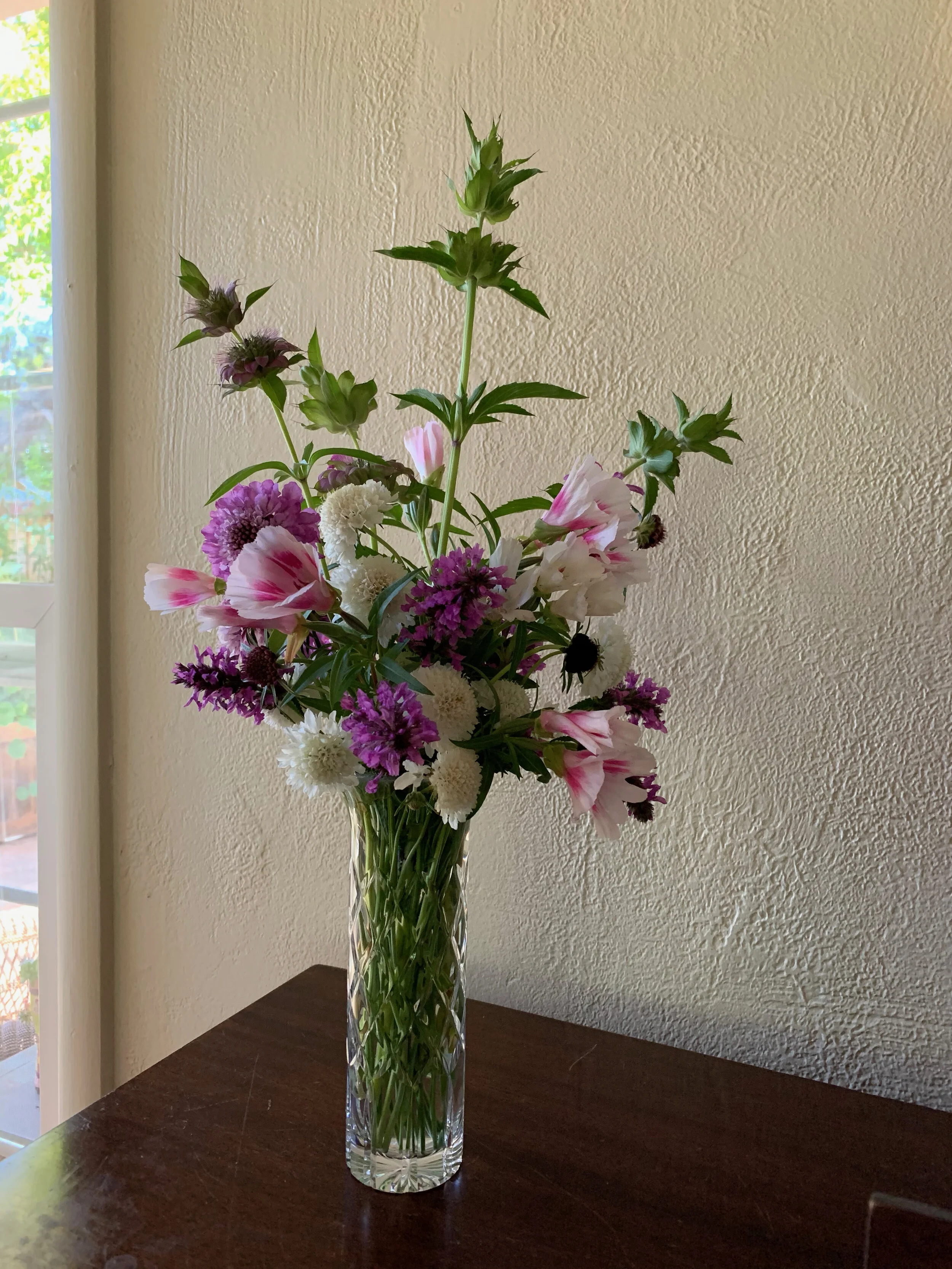
I really like to go out into the garden with some clippers, choose certain flowers that I love, and make an arrangement in my hand. A posy, of sorts. Nothing fancy, nothing terribly creative, just wading through the blooms and picking what catches my eye, and then plunking them in whatever vase is handy at the moment. This is my favorite kind of arrangement.

Today, the Monarda citriodora (bee balm or wild bergamot), Scabiosa atropurpurea (pincushion flower), Agastache (sorry, can’t remember which kind), and Clarkia ‘Farewell to Spring’ were calling me, so that’s what I chose.

IMG_4644.jpg

I’d love to know what’s growing in your garden!

Tags seasonal flower arrangement, flower garden
Comment
← Newer Posts Older Posts →

Subscribe

Sign up to get email when new blog entries are made.

We respect your privacy. We're only going to use this for blog updates.

Thank you! Please check your email for a confirmation notice to complete the subscription process.

Powered by Squarespace