Basil

I always grow a ton of basil, primarily for using fresh. However, last year I put up (in the freezer) about 15 pint jars of homemade pesto, and we were very glad to have them, mostly for school lunches (my kids take thermoses to school 2-3 times a week to have a break from sandwich-like foods; neither one will buy school lunches). But the quality of the frozen pesto wasn't nearly as good as fresh - we ate it and we liked it, but after having the first fresh pesto of summer, we realized how much better fresh is. Unfortunately there's no way to have fresh pesto in winter, we're just going to have to either manage with frozen, or buy pesto whenever we want it, which for me is consumerism at its worst (where is that basil coming from in December, anyway? There's nothing local about that unless you live in Mexico) - so, I guess I'll be making big batches of pesto for the freezer. But first, I wanted to try freezing pureed basil in oil ice cubes. I did this last year with cilantro, and we ended up not using a single one. But I figure basil cubes might be handier - like for when I open a jar of tomato puree to have on pasta, adding a cube or two of basil might be nice. 

I put some special ice cube herb freezer trays on my wish list and got them in my stocking this past Christmas. The Ball company makes them. They come in a set of two with lids.

I picked a full basket of basil, which basically fills up the food processor. 
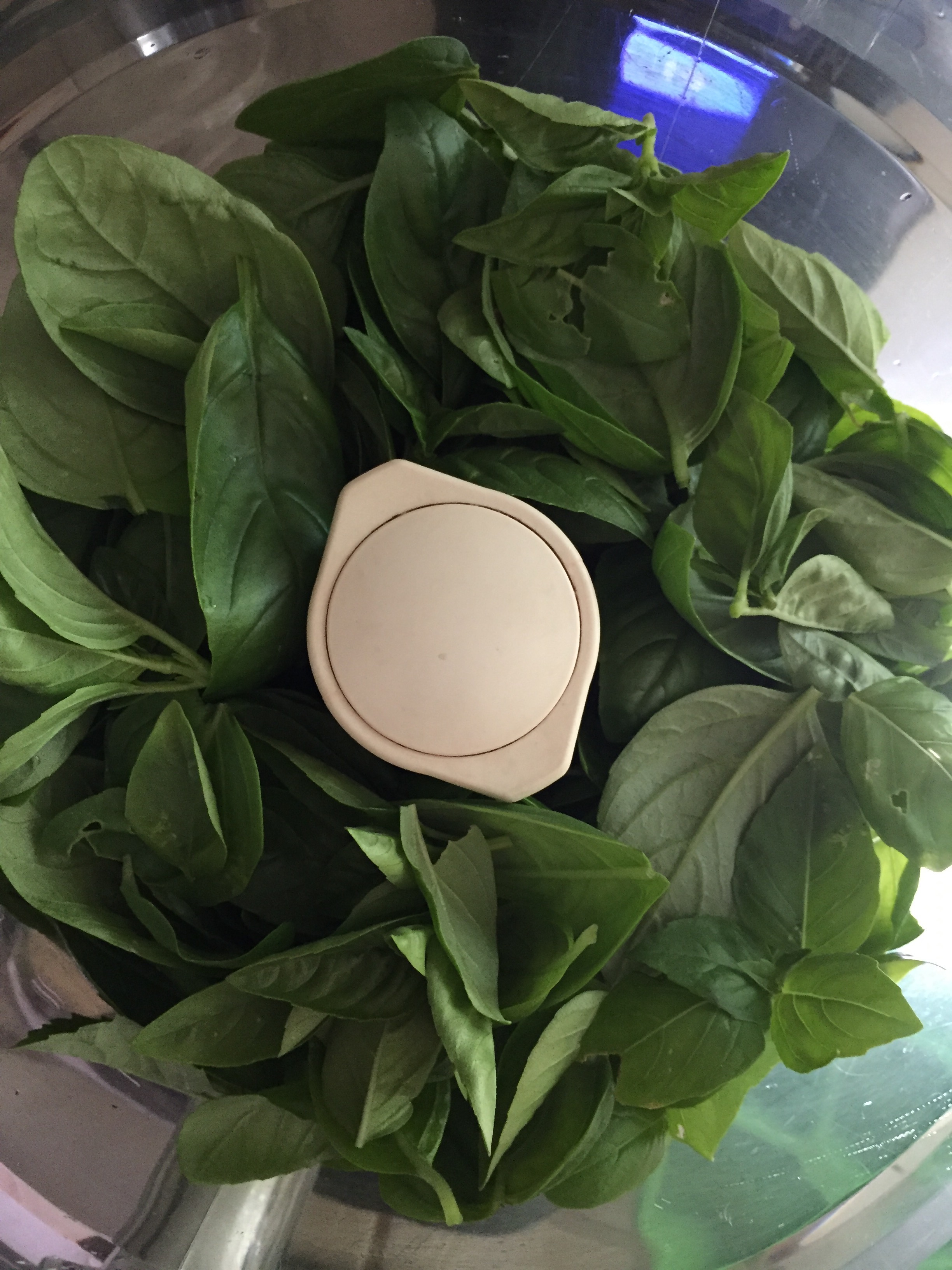
I process the basil, then drizzle oil in through the top, just until I have a paste. Then spoon the mixture carefully in to the trays. A whole basket's worth of basil made very little puree.

Bummer. I'll have to do this again, several times. I will also probably do this with cilantro and maybe with thyme, and make sure I use them up this winter!

I also spent some time canning more roasted tomato puree this morning. The daily harvest of tomatoes is finally reaching a satisfactory amount. I usually roast the cherry tomatoes with garlic, basil, and olive oil for freezer sauce. The larger tomatoes either get turned into puree, crushed tomatoes, or salsa, in a sort of round-robin pattern.  

I love looking at a bountiful harvest of tomatoes.

I was starting to get a little mad at the canning ring situation in the kitchen. We have a basket on a shelf that was overflowing with lids and rings. So I left the lids in there, and took all the rings out, and put them on bungee cords and hung them next to the garlic - one cord for wide mouth, one for regular mouth. This small hack has literally changed my life. The rings are easy to get on and off, and they are much neater and definitely out of the way! 

As you know, you need fresh lids for canning, but the rings can be used several times before being retired. I also use old lids and rings for freezer preserving, or anytime we have leftovers to go in the fridge. Mason jars have become our go-to for pretty much any kind of food keeping. The only place we use plastic is in the kids' lunches.

One more pretty image to share with you - I picked all the Bishop's Lace seedheads in order to save the seed. This is one of the prettiest seed arrangements I have ever seen. Nature is often so surprising! The seeds are green an purple - the purple ones are drier. Gorgeous.

Bishop's Lace is in the carrot family, like Queen Anne's Lace and a lot of herbs (parsley, coriander, dill, anise) and some poisonous things like Water Hemlock. Don't pick and eat these things in the wild unless you are 100% sure of what you have found. This family used to be called Umbelliferae because of the flower shape (umbels), but is now called the Apiaceae. I don't know why. One thing is for sure, insects very much love this shape of flower, so it's good to include them in the garden for pollinators!

Garden Tour/Canning Crushed Tomatoes

Last night I had the pleasure of hosting a large group of women for a tour around our farm. These ladies do good work - helping other women start businesses, helping young girls go to college if they wish, and providing funds for women looking for a new start in life. It was an honor to have them here. Very few were gardeners, but they were willing to look around and hear a bit about our philosophy, as part of one of their monthly meetings. They had great questions and were game to troop around in the mulch. I even found that one of them is a UC Master Gardener (hi Theresa!) and one is hoping to be, just like me (hi Robin!). I love walking around the garden and talking about what we've done, and I love turning folks on to different ways of having a suburban yard. This crowd was especially gracious, given that so many of them were not really 'into' gardening. Thanks to them and to my neighbor Karen for a great evening!

This morning, given some cooler weather, I decided it was time to start on my annual stockpile of canned crushed tomatoes. One of our tomato plants in particular had a LOT of ripe fruits on it - a variety called "Mortgage Lifter." For those of you who haven't heard the story of this pink, 1-2 lb heirloom tomato, it is said that M.C. Byles of West Virginia crossed varieties for six years until he introduced this one in the 1940's. After he sold the plants for $1 each, he was able to pay off the $6k mortgage on his house, and he named the variety, Mortgage Lifter! It's a beautiful fruit indeed.

Hello, lover

Hello, lover

They are large, juicy, and very tasty, and I like them a lot despite the fact they won't be paying off any mortgages around here, more's the pity. Today I used quite a few of these particular fruits, along with a few Black Krim, a few Nebraska Wedding, and several paste tomatoes of differing varieties.

Mortgage Lifters on the left 

Mortgage Lifters on the left 

Here's my process: I cut out the stem, mark an 'X' in the fruit close to the bottom, dip them for a minute in boiling water, then plunge them into ice water. I slip off the skins and rip the fruits up with my hands, discarding many of the seeds as I do so (skins and seeds and extra juice goes to the chickens, though I like a few seeds in my jars too). Then I put all the ripped-up fruit in to a big pot, and bring it to a boil, stirring and crushing as they heat up. I boil them for five minutes, then put them into warm sterilized canning jars leaving a 1/2" headspace. Release the air bubbles, add 1/2 teaspoon of citric acid per quart, clean the rims, and water bath can for 45 minutes. Mine always end up with lots of juice, but that's ok. We tend to use these canned tomatoes for chili or ragu, both of which are only improved with extra juice.

Did you know that the nutrition of tomatoes increases when they are cooked or canned? True!

We tend to use 1-2 cans of crushed tomatoes every month, so ideally I'd like to preserve at least 12 quarts, double that would be better. If you don't grow tomatoes of your own, now is the time to hit your local farmer's market and stock up on your own crushed tomatoes for winter!

Oh yes, I also want to recommend a film, which I haven't seen yet, I just know it's going to be good (I heard about it on 'Forum'). I somehow missed the showing on our local PBS station, but I'm trying to find another place to see it locally, or maybe I can host a screening. The film is called 'Changing Season: On the Masumoto Family Farm,' and it's about a peach farm in the central valley of CA. It's a somewhat famous farm here for their lovely, organic, drought-resistant peaches. I've been longing to try a program they have in which you 'adopt' a tree, then go to the farm and harvest the fruit when it comes ripe. Doesn't that sound fun? Unfortunately the farm is hours away from here, so I have to figure out logistics. Field trip?

Varieties of Paste Tomatoes

I'm growing six kinds of paste (or plum, or roma) tomatoes in my garden this year. I am searching for the perfect tomato for making sauce, and here are my requirements: I want them to be large and prolifically producing, with a greater ratio of meat to juice, plus a resistance to Blossom End Rot (which tends to be a big problem for me in paste tomatoes), and, of course, they must also have a delicious flavor. I don't want much, do I? 

Last year I grew two varieties, Amish and Baylor, and of the two, I preferred Amish. So this year I included one Amish paste variety. It's a great tomato, round rather than long, with a nice meaty interior.

Amish Paste, on the vine

Amish Paste, on the vine

a ripe Amish Paste

a ripe Amish Paste

It's not the largest tomato, and I've had a few problems with both Blossom End Rot (BER) and Sunscald with this variety. It's a reliable producer. I grew this one from seed. It's an heirloom that comes from an Amish community in Wisconsin. According to Seed Savers, which is where I bought all my tomato seed this year, this variety is generally a favorite of canners. 

The next five varieties are new to me this year. The most disappointing of the lot is Pompeii, which I did not start from seed. I bought it as a seedling, and it was grown from seed obtained from my favorite seed house, Renee's Garden. It's a hybrid. It was an early contender, having been the first ripe paste tomato in my garden, and in fact the first ripe tomato altogether (usually the cherries are first to ripen here). But almost immediately, it developed a case of BER that I haven't been able to shake. I have had very few of these tomatoes make it all the way to ripe. Plus, they're small, though they are prolific. The bottom line is that I have a huge crop of tiny thin tomatoes with BER. Not acceptable. I will not be growing this variety again. (Interesting note, this variety has a sort of dimpled bottom - wonder if that contributes to BER in some mysterious way?)

Pompeii on the vine

Pompeii on the vine

ripe Pompeii

ripe Pompeii

The next variety is the only Determinate tomato I grew this year. I did not grow it from seed, I bought it as a seedling, but I do not know the origin of the seed. It's La Roma III, a hybrid. Apparently lots of folks grow La Roma exclusively, as they are considered one of the most superior varieties. It's not my favorite. The fruits are small, though the plant is prolific. I keep expecting a harvest 'all at once,' because Determinate tomatoes are supposed to work that way - it fruits at once and ripens at once, which would be handy for making a lot of sauce in one big batch. But I've had a few at a time, like Indeterminate varieties. Also, I shouldn't have grown one Det. among all the Ints., because it's a completely different size, much shorter than the others, and so it's hard to include in my Florida weave system of staking. The good news is, I've had no BER in this variety.

La Roma III on the vine

La Roma III on the vine

La Roma III, almost ripe

La Roma III, almost ripe

The next variety is an heirloom called Federle, which I grew from seed. The seed is originally from West Virginia. It's got a long, thin shape, but the shoulders are meaty, and it's quite a bit bigger than the previous three I've mentioned. It roasts beautifully for sauce, is incredibly prolific, and has had minor problems with BER. I bought it because it is supposed to be particularly good for salsa, and it has few seeds.

Federle on the vine

Federle on the vine

ripe Federle

ripe Federle

Another long, thin variety that I'm liking is Opalka. This is one I grew from seed. It's a Polish heirloom that has few seeds, therefore it's meaty. It's big - most of the fruits are six inches long, I've had no problems with BER, and it's been a prolific producer. I'm sorry I don't have a picture of a ripe one for you just now, but here's one on the vine.

look at that gorgeous, fat Opalka tomato - and there's more where that came from.

look at that gorgeous, fat Opalka tomato - and there's more where that came from.

I think my favorite variety of all is Rocky, which is one I did not grow from seed - I bought it as a seedling, and I do not know the origin of the seed. It's an heirloom from the United States. This is an exceptionally big tomato, extremely meaty, delicious to eat fresh and also great for sauce. It's had zero BER issues and has been very prolific. My only beef with this variety is that it has a fragile stem and needs a lot of support, and the leaves are droopier than any of my other paste tomatoes, which means it is always looking half-dead. But man. The tomatoes. They're long AND fat. I love them.

a bunch of heavy Rockys

a bunch of heavy Rockys

a plump, ripe Rocky

a plump, ripe Rocky

I believe I will begin to save some seed from Rocky, Opalka, Amish, and Federle, for next year. Hopefully I'll also have room for several new varieties.